3 4 5 6 7 8 9 10 11 12 13 14 15

Writing Cliché #3 – Dream sequences

Writing Cliché #3 – Dream sequences

Oh shit how are we going to write ourselves out of this mess? It’s ok, let’s just have the character wake up and it was all a dream and everything is back to normal. Yay!

NO YAY!

I cannot think of a lazier, more boring and unrealistic way of getting your characters out of a mess. Not only that but it derails the plot and all development that has take place to this point, and leaves readers and characters floating and confused (and pissed off, that’s a lot of time and energy we’ve just invested in a plot line you canned).

“But I’m just having a character describe a dream they are having, that’s ok, right?”

Maybe. It all depends on why. I’m not saying there are no good reasons and no good ways, but there are a lot more bad reasons and bad ways, so let’s look at a few. As always take these as guidelines and things to think about, not hard and fast rules. (Because I hate those).

Bad reason #1 – To impart important information

Our hero is unsure what to do next and is in need of guidance, and lo and behold here comes his dead mentor in a dream, despite the fact his mentor is dead and has no psychic link to him whatsoever. Of course magic can be trotted out to cover any number of holes, but it does beg the question, why would you want to?

If your hero is hanging around waiting for a dream cue, then he’s passive and dull and lacking a goal. If he has a goal and a plan to achieve it, then he doesn’t need a dream to tell him what to do next.

And if you do go ahead and write a scene in which a character has a dream containing important information via some magical connection, then please, PLEASE, PLEASE, don’t use it as way of creating some cheap tension by having the character wake up JUST BEFORE the most important piece of information is received. You would have to have a very good reason and do this extremely well or your manuscript may well be thrown across the room.

Bad reason #2 – To be prophetic

This is similar to reason #1, but instead of giving us information, we are given a view of the future (as it may or may not turn out) and again most writers use this as a form of cheap tension. “Oh no! Will Billy really fall out of the tree and break his neck landing on an oreo like in his dream? I had better read on and find out.”

Again there are ways you could use this to great effect if dreaming is a core part of your plot and your world (think ‘Inception’), but more often than not it is going to fall flat. Find another way to maintain or create tension.

And remember that dreams happen to one person, so unless you have mysticism at play no special knowledge comes to us in dreams. To quote Pyramids by Terry Pratchett:

“If you’re expecting a bit of helpful ancestral advice, forget it. This is a dream. I can’t tell you anything you don’t know yourself.”

Bad reason #3 – To be all artsy

This is the reason I wrote my first dream sequence when I was sixteen. I had a character wander into a magical cave and sleep there, giving him an excuse to have vivid, partly prophetic, but mostly artsy dreams that could only be connected to the plot/motivations/struggles via the most esoteric of contortions. It neither furthered the plot nor added to his character development, but because I was exploring fancy descriptions and themes and imagery I felt like a REAL writer. It’s a stage. Write your artsy dreams then delete them. Or save them in a folder somewhere deep and meaningful on your hard drive.

Good reason #1 – To show something your character has failed to deal with

Think Eddard Stark having the same dream over and over again. (Game of Thrones for those not in the know)

Is your character anxious? Were they abused as a child? Are they afraid of dying? Fear come to us in dreams more than joy does, which makes a dream the perfect place to explore a character’s subconscious, especially when they are not self-aware enough to know these things about themselves. This is a great use for dreams because we have all been there, we have all had dreams of things we are dreading or nightmares born from things we have never gotten over. Use this and you are using dreams not only realistically, but with purpose. You’re reader will also be able to relate to what is happening.

Good reason #2 – To reveal the subconscious

This overlaps a bit with reason one, but the previously quoted Pyramids by Terry Pratchett uses dreams this way. While new information is not imparted in the main character’s dream, suspicions his subconscious has been working on come to the fore leaving him with a realisation upon waking.

Another example here would be in the Harry Potter series by JK Rowling, where dreams show us (without having to tell us) that Harry and Voldemort have a lingering connection. It is a logical time for this to become obvious, as when we sleep we are the most vulnerable and the most open.

To dream or not to dream… That is the question…

It boils down to this. If you want to know whether it’s a good dream sequence or a bad one, think about why you are doing it. Remember that most people don’t have truly lucid dreams. They can’t control what they are dreaming about. Dreams themselves are odd things, fluid and ever changing, often not making sense and rarely well remembered. No one really knows what they are, whether they are formed by our memories neatly packing themselves away, or by our subconscious working on problems and anxieties. Mostly they leave feelings, sometimes peace, other times fear or uneasiness or sadness.

Dreams are safer used to tell us something about a character than to further a plot. Although as I always say these are merely guidelines, not rules. Break them if you can.

 

Writing Cliché #2 – Unconscious transitions.

Writing Cliché #2 – Unconscious transitions.

It’s the end of an action scene, all flying swords and glinting axes and blood and brains and damn it how do we get Bob out of here without totally fucking up the pacing? Oh, I know, he gets knocked unconscious. Easy. I can put in a chapter break and he can wake up in the hospital next morning.

Done

Once again this is something we have no doubt all read somewhere. And once again I can put my hand up to having used it before in some of my thankfully unpublished work.

As I’ve said before, clichés are cliché because they work. This is certainly true. It does get the reader from point A to point B without losing pace and with the minimal amount of effort. But there is a fundamental problem with this concept. Namely –

Brain Damage

Being knocked unconscious is a concussion. There are reasons why sporting codes the world over are changing their contact rules to minimise the chance of concussion, and has anyone seen that Will Smith movie all about chronic traumatic encephalopathy, or CTE?

My first aid guide informs me that the first thing I should do if someone is unconscious from a concussion is

CALL THE FUCKING AMBULANCE!

(Ok, it hasn’t got the f-word in it, but it should, that would be fun). And the longer the person stays unconscious from a blow to the head the more likely they are to suffer brain damage and turn into a complete vegetable.

So unless this is the outcome you’re after (all good if you are) then don’t do this. Even worse than the warrior in a fight is the poor stupid investigator in all too many crime novels, goes snooping around where they are not wanted, ooh what is this? BAM! Knocked out. Wakes up tied to a chair. Wakes up feeling groggy and with an aching head but capable of fairly coherent thought and witty banter with their captor. No. If you’re hitting someone on the back of the head you are much more likely to kill them.

All right then, so how about the trusty chokehold?

The chokehold or stranglehold is a hold that restricts the passage of air or blood passing through someone’s neck resulting in unconsciousness (and on rare occasions death if not done correctly). It can be achieved without having greater physical strength and so can theoretically be done by anyone who can get their arm around someone else’s neck. (I don’t suggest you try this at home, but go ahead and do whatever you like to your characters). Keep in mind though, that the length of time someone would be unconscious from a properly done chokehold is only about 20-30 seconds.

“So is there any situation where this can work?”

The only way this concept flies at all is if magic is involved. And there you have to be very careful not to be invoking deus ex machina just to achieve your ends. And logical rules should still apply. A magical blow/explosion should still knock you unconscious in the normal way, while some kind of potion or spell might sap consciousness for an extended period of time without causing damage. Even if this is the case, keep in mind that the body still needs to survive. It’s a machine that must continue to run (unless we’re in a magical stasis bubble). So depending on the length of time, the body will require water, food and air, and will continue to shit and piss in a delightfully unmagical way.

Gross

Next Cliché: Dream Sequences

Should I Self-Publish?

“Why did you self-publish?”

I get asked this question a lot, often with the unspoken assumption:

“You weren’t good enough to get a real publisher so you did it yourself, right?”

There are so many self-publishers out there, and so many who are doing a terrible job of it, that I can understand this assumption. It is the true state of play for a lot of self-publishers –

Tried to get a big publisher interested, kept getting knocked back – did it myself.

Or

Too scared of even trying because I can’t handle criticism or rejection – did it myself.

But now and then you come across a self-publisher/author-publisher, or whatever you want to call it, who has taken this journey for a different reason. The two most common ones I hear are:

“I write niche fiction that no big publisher will touch because it doesn’t fit into their neat little marketing boxes.”

“I wanted more control over my product. Over my art and my editor and everything.”

Quite boringly I fall into category number two. I’m a perfectionist. I am obsessed with my work, with improving my craft, with presentation and details and branding. A lot of authors prefer to have someone making the big decisions for them so they can just get on with the business of writing, and I get that, but I get so much joy from every stage of the process that letting someone else take over the post-production would make me sad. I don’t want to miss out on half the fun.

So as a complete no one I decided that this was the path I wanted to take. I could have tried to make a name for myself in the writing world first by hunting that Big 5 publisher, and the decision not to was no easy thing. I knew it would be hard work, that I would be hacking my way through untraversed ground with a machete, that I would have to learn so much if I was ever going to make it work, but that was the adventure I chose.

Not because I couldn’t get a publisher. Not because I was afraid of criticism. But because I had a dream and the road to that dream had two paths and I chose the thorny one knowing it would be harder but ultimately more fulfilling and rewarding.

So… should I self-publish?

Of course everyone is going to give you a different answer depending on their own experiences, beliefs and prejudices. Self-publishers might rave about their followings or talk about how the publishing industry is going down the toilet and they don’t want to get flushed with the tangled mass of red tape and old-school ideas. Traditionally published authors might talk about the support they get or natter about social media and blogs and twitter followers. But no matter how compelling any of it might be, don’t ever EVER let anyone else tell you what to do with your career.

Let’s assume for a moment that you have a wonderful manuscript (because until you do you shouldn’t be contemplating either) the choice of whether to self-publish or traditionally publish it is a deeply personal question. It depends on whether you are able to step outside yourself and promote it. It depends on whether the nitty-gritty of production interests you (because if it doesn’t you’ll hate it and therefore do it badly). It depends on what your dream actually is and how thrilling or frightening you find the prospect of the journey.

Because if you hate the idea of having to:

 write your own blurbs

 and choose your own art

and your fonts

 and liaise with your typesetter

and your printer

and learn the difference between recto and verso

 and comb through proofs

and deal with contractors

 and money

and withheld tax

and registering ISBNs and barcodes

and a million other things besides…

… then damn well get yourself a traditional publisher now and get on with writing awesome book after awesome book. But if all that sounds exciting, and promotion is within your social ability, then maybe self-publishing might be your road. Either way, no one can tell you what suits you, or what is best for you, except for you.

That wasn’t very helpful!

Well if it helps I can give you a list of shitty reasons to self-publish.

(Complete with percentage of shittiness because I quite like math)

  • Because some dodgy statistics said self-publishers make more money
  • Because someone told you to
  • Because you’re afraid of having to deal with the criticism of an editor
  • Because every publisher and agent on the face of the earth has turned it down

If you are considering self-publishing, ask yourself two questions.

“Is the book actually ready? Like… REALLY ready. If your manuscript isn’t good enough for a traditional publisher, then it isn’t good enough to be self-published either. The only difference between the two should be the method, not the quality of the production.”

“Are you the sort of person who likes dealing with other people and nitty-gritty details and essentially juggling three different jobs and contracting out the rest?”

If you said yes to both of these, then you could self-publish. But that doesn’t mean you should. Should is a matter of business sense. It’s a matter of your feelings, your dreams and your goals, and that is the part where I can’t, and no one ever should, tell you what to do.

If you enjoyed this then why not check out some of my other discussions on writing and publishing in my Storywork series? Check out my You Tube channel for Storywork videos or follow me on Facebook!

Dialogue Attribution

Dialogue Attribution

Dialogue attribution is the fancy name for the words that come at the end (or sometimes the start… or even in the middle) of a line of dialogue. It is the ‘he said’ ‘she asked’ ‘they shouted’ portion of your sentence and there are some general guidelines to abide by when using them. Yes, I don’t like hard and fast rules, but this is one of those areas where playing fast and loose with the guidelines can (and will) see your manuscript thrown across the room by a frustrated editor.

So let’s look at the three rules guidelines …

1

Don’t use them too often

Not every single line of dialogue needs to be attributed thanks to some very handy rules of grammar and social understanding. When two people are having a conversation it is normal to alternate who is speaking. Wendy says something to John and then John says something to Wendy (I’m reading Peter Pan to my daughter at the moment, so complain to JM Barrie about the choice of names). And when John is finished speaking it is either the end of the exchange, or Wendy is going to say something back. Then it’s John’s turn. Then Wendy’s. You get the picture. And since each time a new person is speaking we use a new line, we don’t need anything more than initial attribution as long as the conversation is only this long. Like so:

“I hate Peter, he’s a bit of a jerk,’ Wendy said.

“Come now, he’s not that bad,’ John replied.

“Yes he is,” Wendy said. “He’s a cocky ass.”

John said: “Hmm… yes, I suppose you have a point.”

On those last two lines we don’t need the attribution. It looks crowded and stodgy, even though I stuck the attribution in the middle and at the start. This works better:

“I hate Peter, he’s a bit of a jerk,’ Wendy said.

“Come now, he’s not that bad,’ John replied.

“Yes he is. He’s a cocky ass.”

“Hmm… yes, I suppose you have a point.”

Now of course if Michael were to come along and make it a three way ball game, we would need another bit of attribution, because a reader would naturally assume that the next person to speak would be Wendy again.

“Yes he is. He’s a cocky ass.”

“Hmm… yes, I suppose you have a point.”

“Is not!” Michael said, stomping his foot.

And again we would then have to attribute to show whether it was Wendy or John who replied (Or Peter :O)

“Do you even know what an ass is?” John asked him.

“No.”

“It’s a donkey.”

(Note that neither of those last two needs a direct attribution because using the ‘every new speaker gets a new line’ rule (please oh please never forget that one) we know John has finished speaking, and as there is no attribution the reader naturally assumes it’s Michael as he was the one John was speaking to.)

2

Don’t use too few

The opposite side of the knife-edge from the previous point, but just as important. While using too many makes everything stodgy and slow, using too few is just plain confusing. Even in a two person conversation, after a few lines it can become hard to follow which person is speaking.

“Nice weather we’re having, don’t you think?” Hook said.

“That’s because kids don’t have any imagination these days,” Peter replied.

“Well at least if we have to go out of business we can do it in the warm sunshine.”

“Sure. Hey, did you see what they did to you in that movie, The Pirate Fairy?”

“Don’t even mention that infernal thing. It isn’t so much what they did to me, but that song? It gets stuck in my head for days.”

“Yo-ho imagine the places that we’ll go–”

“Stop it!”

“The finest of tortures.”

“I wouldn’t lord it up, at least I was voiced by the guy who plays Loki. The latest movie about you got only twenty-seven percent on Rotten Tomatoes.”

“I don’t read reviews. People love me.”

Now, I’m not saying that it’s impossible to follow, but it’s certainly not easy. This is where it becomes good to hang a few reminders on there. It doesn’t even have to be direct attribution, just using the character’s name in connection to some action they are performing while speaking can work just as well.

“Nice weather we’re having, don’t you think?” Hook said.

“That’s because kids don’t have any imagination these days,” Peter replied.

“Well at least if we have to go out of business we can do it in the warm sunshine.”

“Sure.” Peter pointed at his old enemy. “Hey, did you see what they did to you in that movie, The Pirate Fairy?”

Hook put his good hand to his brow. “Don’t even mention that infernal thing. It isn’t so much what they did to me, but that song? It gets stuck in my head for days.”

“Yo-ho imagine the places that we’ll go–” Peter sang.

“Stop it!”

“The finest of tortures.”

“I wouldn’t lord it up, at least I was voiced by the guy who plays Loki. The latest movie about you got only twenty-seven percent on Rotten Tomatoes.”

“I don’t read reviews,” Peter said. “People love me.”

Peter pointing in line four and Hook putting a hand to his brow in line six aren’t direct attribution, just gentle reminders using action. These also help to anchor the dialogue to its physical speakers, rather than having the words floating in a void as though the voice has no body. Sometimes it’s more necessary to do this than others. If you have two characters sitting across from one another at a table and the main point of the scene is their conversation, then there is less need to run the action alongside. But if you have two characters creeping through the undergrowth tracking an animal and holding a whispered argument about which one of them should carry the bag of peanuts, then a larger chunk of action will have to run alongside the dialogue or we’ll lose sight of what the characters are physically doing.

3

Almost always use said

Thesauruses (thesauri?) are fantastic things, especially for that word that is on the tip of your tongue and you can’t quite remember what it was, but the one thing you should never use it for – ever – is coming up with interesting dialogue attributions.

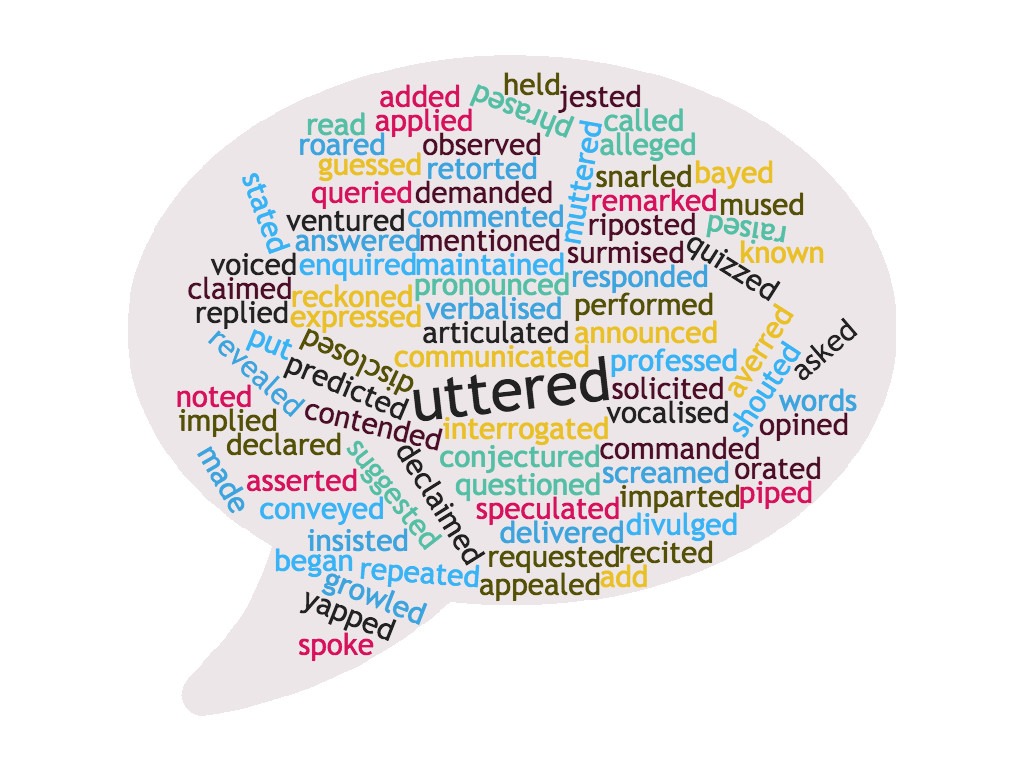
My trusty (and very worn) Oxford Paperback Thesaurus, third edition, published in 2006 (thankfully before words like glamping and budgie smugglers got the green light) informs me that there are numerous replacements for ‘said’ such as:

Urgh ok, I could go on forever, but I don’t think I can handle much more. It is all very colourful and interesting when just considering the great depth of the English language but as soon as you put them into your writing it is distracting. Now, I’m not saying you can never use any of them ever, some of them have a place, but ALMOST ALWAYS USE SAID. Said disappears. It is so mundane and dull a word that readers barely see it. It just vanishes leaving the character’s name or pronoun floating there ready to be connected to their words. Said doesn’t get in the way. It has no agenda. It is only ever trying to be discrete and helpful. Even when your character is asking a question, said is often enough, although asked is pretty invisible too.

So which of the above words are ok on occasion and which should you steer clear of like a plague infested shark pit? Well they fall loosely into three camps.

1

Great used in moderation in appropriate circumstances.

In the first camp we have words like: shouted, screamed, growled, muttered, whispered. Even demanded, ordered and announced could go in there. These are words that convey their own meaning separate to either the golden words said and asked. They are visceral, ‘shouting’ is more than ‘saying with great volume’ as ‘whispering’ is more sibilant than ‘said quietly’. Ordered can give us a sense of authority difficult to attain in certain circumstances, as announced can give flair to the words of a very confident character that ‘said’ could never achieve. These are wonderful words when used sparingly, in appropriate circumstances. The more you use them the weaker they become. So be careful and don’t get too repetitive.

2

Fuck right off and close that thesaurus.

The second camp contains words like: queried, stated, uttered, voiced, remarked and noted, words that are nothing more than direct synonyms of either golden word said or asked, with no other purpose. Use a flamethrower to get rid of these.

3

Stop repeating yourself.

The third camp is the hardest to weed. These are sneaky redundant tags – essentially the attributive equivalent of a tautology. Examples are: guessed, repeated, alleged, divulged and solicited.

What do you think it is?” Joe asked.

A washer?” I guessed.

In this situation, the word guessed is totally redundant. The situation and the question mark tell us that I am guessing.

I think he killed Bob Darling,” Brittany alleged.

No point in telling us it was alleged. Already got that from the words, thanks all the same.

What does it say?

It says: ‘Don’t go anywhere, I’m coming to get you’,” Chad divulged.

Don’t need divulged. It’s trying so hard to be useful and clever, but really it’s just tripping over its own smugness.

You get the idea. These words are sneaky bastards. They will creep into your first drafts here and there and even into your rewrites if you aren’t careful. Prune them. Viciously.

Once you’ve gone through and butchered your mentions and your comments and your queries, there is still one more problem. How do you convey more than just dialogue attribution using just the word ‘said’? Like I said, it’s invisible, it tells us nothing other than who is speaking. How do we know that Johnny is joking if we don’t say “Johnny joked”? And why should I bother piss-farting around with other words when “Johnny joked” gets the point across quickly.

Two reasons

1

One we have already covered – fancy attributions are distracting. But they are also demeaning because of reason two.

2

Show, don’t tell. Don’t tell me he was joking. Let me figure it out myself. Show me his grin. Show me his tongue poking out. Show me the twitch at the corner of his lips as he tries to keep a straight face. Show me anything, just don’t tell me.

“And I thought you were clever,” Johnny joked.

“And I thought you were clever,” Johnny said, his lips split into a grin.

Yes, it’s more words, but there’s a difference between full words and empty words. Don’t take cheap shortcuts.

So what do you need to do? Look at every single dialogue attribution as you go and think to yourself – why haven’t I used said. Or asked. Am I trying to get across something more meaningful as in camp 1? Or am I trying to prove that I’m clever, as in camp 2? It is a natural error. I can remember my early pieces of work being littered with this stuff. I even dog-eared the pages for said and asked in my thesaurus. I spent a long drive bitching to my mum about how JK Rowling couldn’t think of anything more interesting to use in Harry Potter than said. We all make these mistakes. We all have to learn. Do not use a clever or fancy word when a simple one will do. That is you getting in the way of your story.